
The agility A frame is one of the most iconic and challenging obstacles in dog agility. With its steep incline and commanding presence, it not only tests your dog’s physical strength and coordination but also their focus and training. Whether you’re just starting out or polishing up for competition, these expert tips and tricks will help you and your pup conquer the A-frame with confidence and style.
1. Start With Confidence-Building
Begin training with a lowered agility A-frame to reduce intimidation and encourage success. Let your dog walk across it slowly at first, rewarding them for calm, controlled movement. Building early confidence prevents hesitation later, and this is good advice for every piece of dog agility equipment that you teach your dog.
2. Teach a Reliable “Climb” Command
Establish a verbal cue like “climb” or “up” so your dog understands when they’re expected to take the agility A-frame. Use the command consistently and pair it with enthusiastic encouragement.
3. Use Targeting for Contact Zones
The yellow contact zones at the bottom of each side are non-negotiable in competition. Use a target (like a treat lid or small mat) and reinforce stopping or slowing at the bottom to build reliable contact behavior. Training hoops also can be a valuable resource when you first get started with dog agility training.
4. Practice Two-on, Two-off or Running Contacts
Choose the contact method that suits your training goals—either two-on, two-off (stopping with front paws on the ground and back paws on the agility A frame) or running contacts (maintaining speed while hitting the contact zone). Be consistent with whichever style you train.
5. Use a Spotter for Safety Early On
If your dog is new to the A-frame or especially enthusiastic, having a spotter can prevent injuries and ensure your dog descends safely. This is especially helpful for small breeds or young, high-energy pups. This is also good advice for other dog obstacles, such as the agility dog walk and the dog agility teeter totter.
6. Train Both Approaches & Exits
Dogs tend to approach and exit obstacles from a variety of angles during a real course. Practice different entry and exit paths to help your dog learn to adjust their stride and maintain control no matter how the obstacle is approached.
7. Add Distractions Gradually
Once your dog is confident, introduce distractions like toys, crowd noise, or handler movement nearby. This simulates trial environments and helps your dog stay focused under pressure.
8. Keep Sessions Short & Positive
The A-frame can be physically demanding. Keep training sessions brief and end on a positive note. Overdoing it can lead to fatigue, stress, or a drop in performance. We always recommend limiting training sessions to about 15-20 minutes, as dog attention spans are short. Be sure to keep a dish of water on hand, as well, and dedicate a few minutes to warm-up and cool-down exercises for safety.
9. Monitor for Physical Strain
Watch for signs of discomfort, especially in older dogs or those with joint issues. The A-frame’s incline can be tough on shoulders and hips, so be cautious and consult your vet if needed.
10. Celebrate Progress, Not Perfection
Not every run will be flawless—and that’s okay! Celebrate the small wins, like a confident ascent or a successful contact hit. A positive attitude builds trust and keeps the learning fun for your dog.
Mastering the A-frame is about more than just speed—it’s about safety, consistency, and building a strong bond with your dog. With these pro tips and a little patience, your dog will be scaling the agility A frame like a champ in no time at all.
In general, with agility training, patience is always key. Never forget that the main goal of agility is to have fun with your dog. Agility can strengthen the bond between the two of you and, of course, provides an excellent workout for your dog. It doesn’t matter if you ever set a paw on an official competition course; agility offers many benefits and fun for the whole family.
Our Dog Agility A Frame
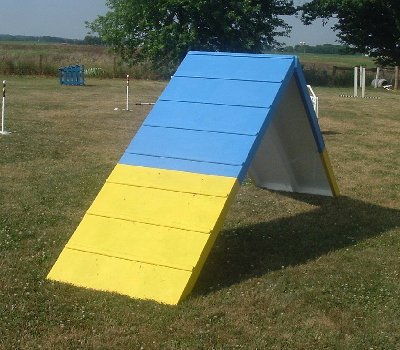
Our sturdy wood A-frame is built to competition standards and includes a clearly colored contact zone. We have 8-foot and 9-foot A-frame options as well as a training A-frame that is ideal for smaller spaces or smaller dogs.
We also sell a handy training hoop that can be used for the A-frame as well as the dog walk. This hoop can make it easier for your dog to understand where their paws must make contact as they enter and exit the contact equipment.
Carlson Agility – Your Dog Agility Superstore
At Carlson Agility, we have every piece of pet agility equipment that you might need for your backyard dog agility course, including the agility a-frame, the dog walk, dog agility teeter, weave poles, the pause table, and all types of dog jumps, including the tire jump. For those smaller breeds, we have a full selection of mini agility equipment. If you are not quite sure where to get started, consider purchasing a dog agility kit, which includes several items.
We even carry unique items such as a dog swing plank and dog sway bridge, commonly seen at UKC events, as well as handy training tools, including a dog plank and wobble boards. Whether you are searching for a quality agility A frame or another item, our equipment is sturdy and built to last, with safety in mind. If you have questions about any of our dog training equipment, don’t hesitate to get in touch with us.